Walmart Just Became America's Second-Biggest EV Fast Charger Builder — And It's Only Getting Started
Every quarter, the US fast-charging market throws up a surprise. This time, it's not a startup or a legacy charging network — it's the country's largest retailer quietly out-building nearly everyone in the industry.
The Numbers Behind the Surge
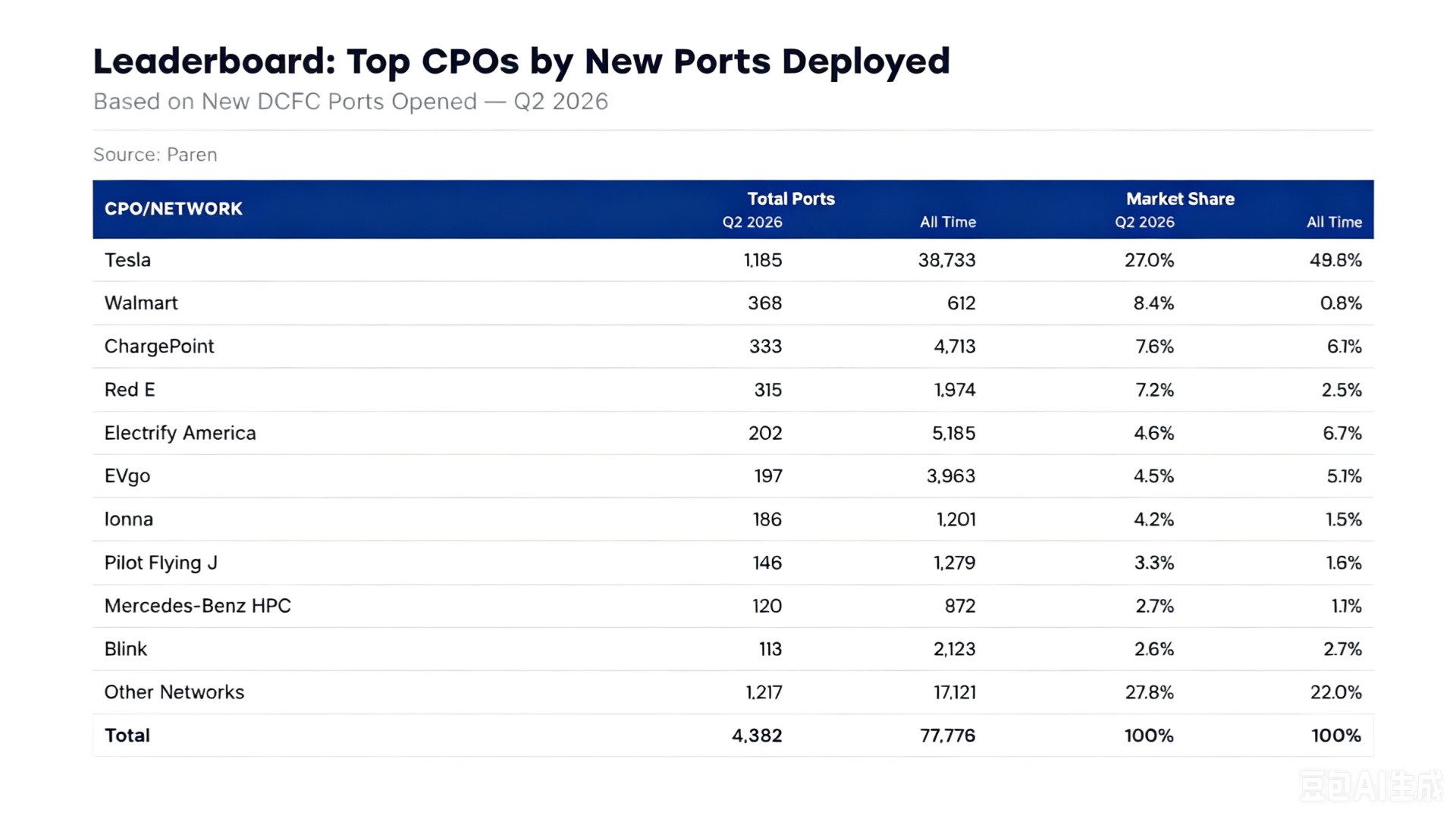
Walmart installed 368 new charging ports in Q2 2026, trailing only Tesla's 1,185 but comfortably ahead of ChargePoint (333), Red E (315), and Electrify America (202). That single quarter accounted for 8.4% of all new public fast-charging ports added in the US — a striking figure given that Walmart's cumulative, all-time market share still sits below 1%.
The trajectory is what makes this genuinely notable. Walmart ranked ninth in new deployments in Q1 2026, and it didn't even crack the top ten in Q4 2025. In roughly two quarters, it climbed to become the second-fastest-growing charging network in the country. Paren's report specifically flags Walmart as one of the "fast risers reshaping ranks" in the industry, noting its Q2 share of new ports (8.4%) dwarfs its historical footprint (0.8%).
This growth is happening against a broader industry backdrop that's actually cooling. Electrek's coverage of the same Paren report notes the US added 4,382 new public fast-charging ports in Q2 2026 — down 10% year-over-year, and part of a 7.4% first-half decline compared to 2025. In other words, most of the industry is decelerating while Walmart accelerates.
Why Walmart Has a Structural Advantage No One Else Has
Walmart's edge isn't capital — every major network has access to capital. It's real estate it already owns outright.
With more than 3,500 Supercenters across the country, Walmart doesn't need to negotiate leases or secure landowner approval the way third-party charging operators typically do. Every store sits on a large parking lot, which means ample space and flexibility to build multi-port charging stations without the site-acquisition friction that slows down competitors. Stores also come with restrooms and food service already built in — exactly the amenities newer charging networks are scrambling to add to compete on driver experience.
The result is a genuinely convenient use case: customers plug in, shop, and drive off with a charged vehicle by the time they're done. Walmart has stated that over 90% of the US population lives within 10 miles (about 16 km) of one of its stores — a coverage radius that's hard for any purpose-built charging network to match without years of site development.
Filling the Rural Charging Gap
Q2's results are just the opening phase of a much larger plan. Walmart intends to install thousands of chargers by the end of the decade, and the geography of that buildout matters as much as the pace.
As Paren's report points out, fast-charging infrastructure remains heavily concentrated in coastal metros, followed by the industrial Midwest, the Southeast, and Texas. Walmart's dense footprint in rural and small-town America — with stations already planned in Nebraska, Montana, Oklahoma, Ohio, and several other states — is positioned to close exactly the gap that coastal-focused charging networks have left open. That matters for EV adoption in states where charging infrastructure has historically lagged behind vehicle interest.
Walmart still has to navigate a patchwork of state utility regulations and local permitting rules, which has slowed even well-funded charging operators before. But InsideEVs' broader Q2 industry analysis notes that charging session volume jumped 29% year-over-year even as new port deployment slowed — meaning demand is outpacing supply in a way that rewards whoever can build reliably and fast. If Walmart sustains its current pace, it could end up doing for rural fast-charging access what Tesla did for the Supercharger network over the past decade: forcing the rest of the industry to catch up.
What This Means for EV Owners
For drivers, more competition among charging networks — especially from a company with Walmart's logistics muscle — usually translates into better uptime, more predictable pricing, and shorter waits at high-traffic corridors. We've tracked similar consolidation dynamics before in our piece on Volvo's Tesla Supercharger network integration, where automaker-network partnerships are reshaping how easy it is to find a working charger on a road trip. Walmart's retail-anchored model is a different path to the same outcome: making fast charging feel as routine as a fuel stop.