The Cybertruck Is Being Cancelled After Three Years. The Numbers Explain Why
For anyone who buys, drives or charges electric vehicles, the interesting part is not the verdict. It is the specific list of what broke — because almost all of it comes back to two numbers that decide whether an electric truck works at all: price and range.
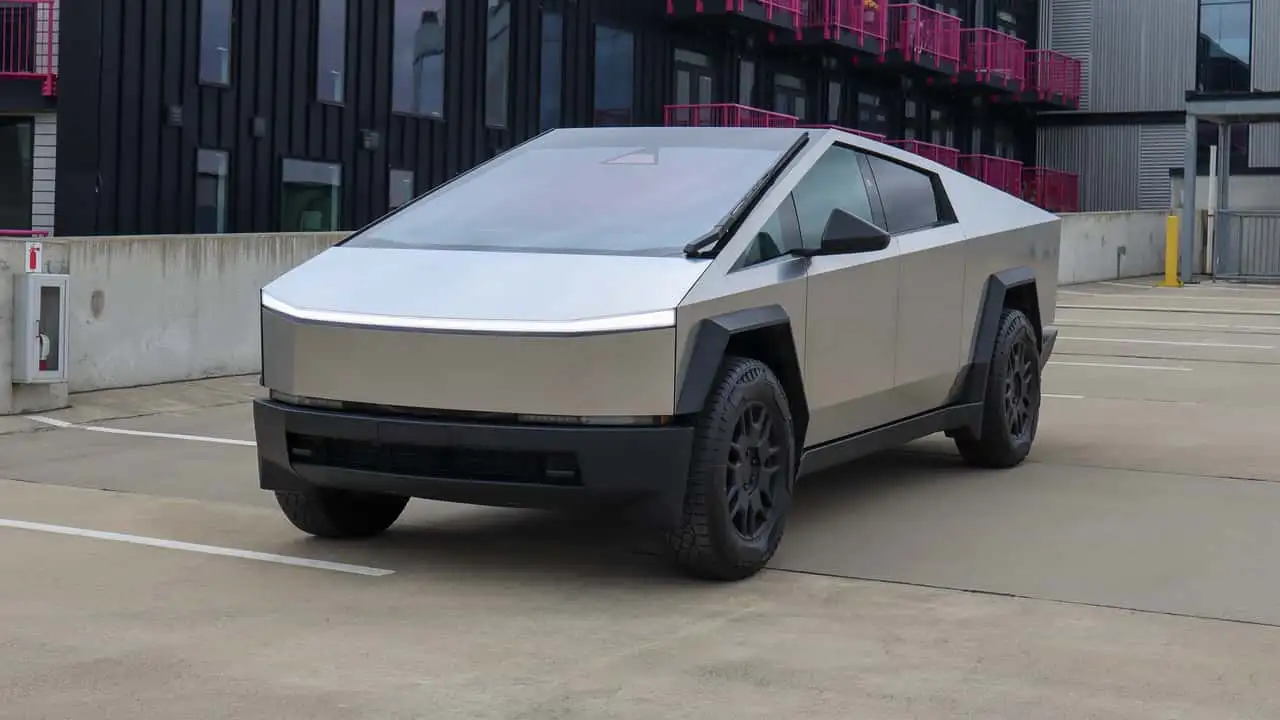
What Was Promised in 2019
At the reveal, Tesla put these figures on screen:
|
Promise (2019)
|
What was delivered
|
|
$40,000 starting price
|
$82,000 for the cheapest version at the end of the run
|
|
500+ miles of range
|
325 miles maximum EPA rating
|
|
0–60 mph in under 2.9 seconds
|
Delivered — the one promise kept
|
|
Towing over 14,000 lbs
|
Not delivered as promised
|
|
Payload up to 3,500 lbs
|
Not delivered as promised
|
|
Seating for six adults
|
Not delivered as promised
|
|
On sale 2021 (2022 for tri-motor)
|
Deliveries began nearly three years late
|
One line in that table explains a great deal. The 0–60 time was the only promise kept, and it is the least important specification to anyone who actually uses a truck for work.

The Price Went the Wrong Way, Three Times
The trajectory is worth reading in sequence, because each step compounded the last.
The promised entry price was 40,000. The first version most buyers could actually get was the tri-motor Foundation Series at 120,000 — three times the base price Tesla had advertised, and $50,000 above the $69,900 it had quoted for the tri-motor.
Then the base dual-motor landed $10,000 above where the flagship was supposed to sit. A $60,000 rear-wheel-drive version arrived late and was withdrawn. By the end of the run, the cheapest Cybertruck was $82,000 — more than double the original promise — and Tesla had stopped taking orders for that version entirely.
No manufacturer can launch a mass-market vehicle at 2× its announced price and expect the volume case to survive. That is arithmetic, not opinion.
The Range Problem Had a Fix. It Was Cancelled.
Tesla promised 500+ miles. The truck's best EPA figure was 325 miles — about 65% of the claim.
That number is fine for daily driving. It is not fine in a segment where buyers tow, and InsideEVs makes the point directly: in a truck market that values towing, 325 miles wasn't enough to win over EV sceptics.
What makes this a charging story rather than a spec-sheet story is what happened next. At launch in 2023, Tesla announced a drop-in battery pack for the truck bed that would lift range to 470 miles. It was cancelled last year, before it ever reached production.
So the range shortfall was not a case of the technology being impossible. It was a case of the fix being engineered, announced, and then withdrawn — which leaves owners and buyers with the 325-mile truck and no path to the 470-mile one.
And the range was available elsewhere. Rivian has delivered a truck with more than 400 miles of range. Chevrolet sells a Silverado EV rated at 493 miles by the EPA for about the same money as a dual-motor Cybertruck. The Cybertruck did not lose because electric trucks cannot do range; it lost while rivals were doing range.
It Was Not Only Tesla: The Whole Segment Stumbled
The Cybertruck's failure is easy to read as a Tesla story. It is also a segment story, and the source data says so.
- Ford F-150 Lightning: Ford planned capacity for up to 150,000 a year. Actual sales never passed 35,000 annually.
- GM's electric trucks: originally planned across two factories at hundreds of thousands of units; the company now uses one plant, Factory Zero, and has idled it for two of the last 13 months. Its next-generation electric trucks have reportedly been postponed.
- The underlying cause, per InsideEVs: the EV truck boom was kicked off by promises of $40,000 battery-electric pickups, and no electric truck built to date has matched the price of a petrol equivalent. Add real buyer concerns about range, towing and charging infrastructure, and the segment was always going to be a hard sell.
That is the honest framing. The Cybertruck was the most conspicuous casualty of a price-and-range problem that hit every manufacturer who tried.

The Volume Gap Was Not Close
Musk said in 2023 — on the eve of first deliveries, not in the optimistic early days — that the Cybertruck could sell 250,000 to 500,000 units a year.
|
Year
|
Cybertruck sales
|
|
2024 (first full year)
|
38,965
|
|
2025
|
down 48.1% year on year
|
|
2026
|
will not clear 20,000
|
Against that, Ford is on track to sell more than 800,000 F-Series trucks this year alone. The vehicle that was supposed to make the F-150 irrelevant will end its run selling roughly one unit for every forty F-Series.

What This Means If You Own or Charge an EV
Three practical lessons sit inside this story, and none of them is about Tesla specifically.
1. Treat announced range as a ceiling, never a floor. The gap between a launch claim and an EPA or WLTP figure is where disappointment lives. Quoted range is also a best-case number in its own right — our explainer on why EV range drops in winter and how much comes back shows how much the same car can vary with conditions.
2. Never buy on a promised accessory. The 470-mile bed pack is the cautionary example: announced at launch, cancelled before production. If a capability matters to you, wait until it exists and can be ordered.
3. Infrastructure is a purchase criterion, not an afterthought. InsideEVs lists charging infrastructure alongside range and towing as the reasons truck buyers stayed away. For a vehicle expected to work — towing, hauling, long days — what matters is where you can charge it, not just how far it goes on a good day. Our guide to planning charging on long cross-border trips covers the checks that decide whether a route is comfortable or a gamble.
The Bottom Line
The Cybertruck is being discontinued because it was priced at more than double its promise, delivered about two-thirds of its promised range, and sold at a fraction of the volume its maker forecast — while a petrol F-Series sells more than 800,000 units a year.
The engineering was not the problem. The promises were. And for buyers, the durable lesson is the least glamorous one: read the EPA number, ignore the launch claim, and check where you can actually plug in before you sign.
FAQ
Is the Tesla Cybertruck being discontinued?
Yes. Elon Musk confirmed that production will wind down next year, ending the model's run just over three years after deliveries began.
How much range does the Cybertruck actually have?
Its maximum EPA rating was 325 miles. Tesla had promised more than 500 miles at the 2019 reveal.
How much does a Cybertruck cost?
The cheapest version available at the end of its run was $82,000, against a promised starting price of $40,000. The first tri-motor Foundation Series cost $120,000.
How many Cybertrucks did Tesla sell?
Cox Automotive estimates cited by InsideEVs put 2024 sales at 38,965 units, followed by a 48.1% decline in 2025. Sales in 2026 are not expected to clear 20,000.
Did other electric trucks sell better?
Not much. Ford planned up to 150,000 F-150 Lightnings a year and never exceeded 35,000 annually, and GM has cut back its electric truck plans.