JLR Is Taking BYD to Court Over the Ti7 — and the Case Is About More Than a Boxy Shape
Jaguar Land Rover has gone to court in the Netherlands over the BYD Ti7, alleging that the seven-seat SUV infringes intellectual property connected to the Land Rover Defender. In August 2026, court-appointed bailiffs searched two BYD offices in the Netherlands and seized digital records relating to the Ti7's development.
No court has yet found that BYD infringed anything. A preliminary hearing was scheduled for 11 November 2026 in The Hague, where a Dutch court will decide procedural questions — including whether JLR's claims can proceed at all.
What Happened, and Where
The searches took place at BYD's offices in Schiedam, near Rotterdam, and Hoofddorp, near Amsterdam. The bailiffs acted on the authority of a Dutch court and on JLR's application, and they arrived unannounced. The records they took are now the subject of the dispute.
BYD's legal representatives argue that the scope of the evidence seizure was disproportionate. Both companies have declined to comment publicly, which is why the substance of the allegations remains unusually thin for a case this prominent.
The venue is not accidental. The Netherlands was chosen because of the strength of its intellectual property regime, and because BYD's European operations sit there — evidence tends to be seized where the documents live.
What JLR Alleges — and What It Does Not Yet Prove
The claim is more specific than "the two cars look alike." JLR reportedly suspects that BYD dismantled a Defender during the Ti7's development and examined individual technical solutions.
That distinction matters legally. Benchmarking a competitor's vehicle is ordinary industry practice; every serious carmaker buys rivals and studies them. What is not permitted is using protected design features or technical solutions in a production vehicle. The question before the court is therefore not whether the Ti7 is boxy — it is whether specific protected features were copied.
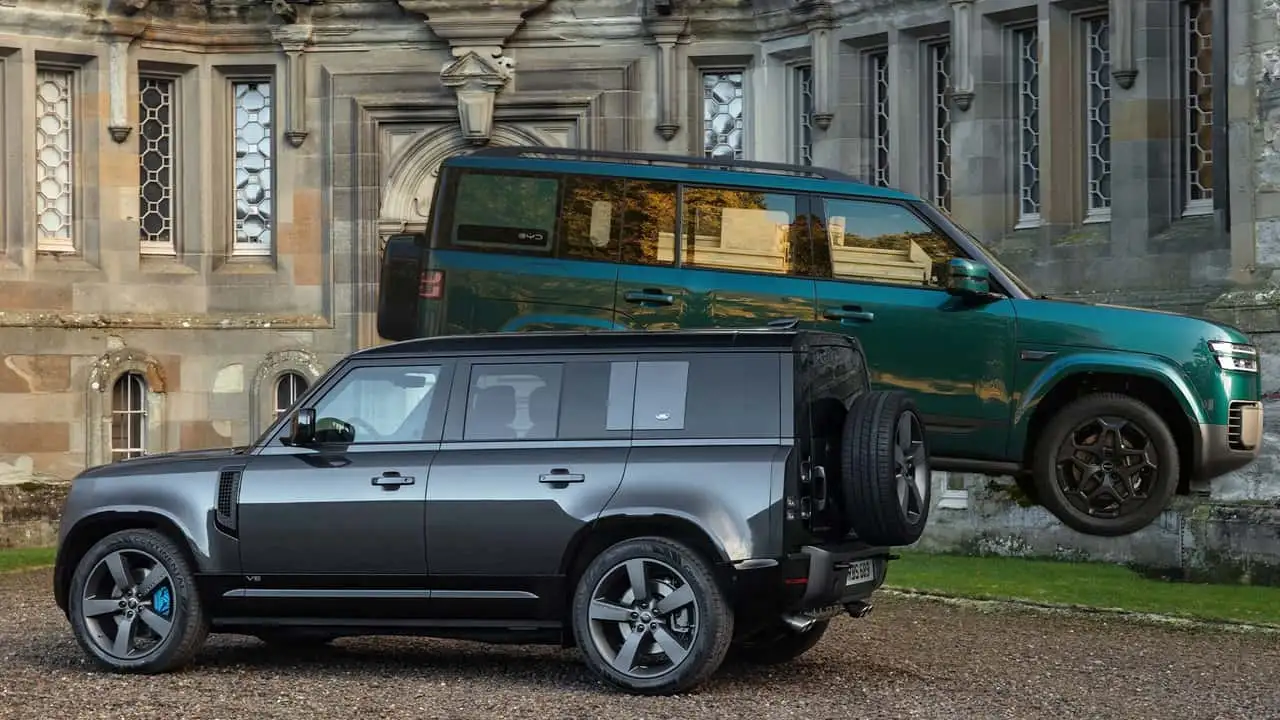
The visual comparison is easy to understand: an upright front end, nearly vertical sides, squared-off wheel arches and a rear-mounted box. That combination reads as deliberately rugged and inevitably invites Defender comparisons. But a similar silhouette is not, by itself, an infringement.
Why the Price Gap Explains the Heat
The commercial stakes are not subtle. The Ti7 lists at £47,995 in the UK, while a seven-seat Land Rover Defender 110 lists at £68,465.
|
|
BYD Ti7 (UK)
|
Land Rover Defender 110, 7 seats (UK)
|
|
Price
|
£47,995
|
£68,465
|
|
Difference
|
—
|
£20,470 more
|
That makes the Ti7 roughly 30% cheaper than the equivalent Defender — arithmetic from the two list prices, and the same gap InsideEVs reports for Europe more broadly: about $64,500 for the Ti7 against nearly $92,000 for a comparable seven-seat Defender 110, again around 30%.
A new entrant arriving at two-thirds the price of an icon, in the icon's strongest market, is exactly the situation in which legal departments get busy.
The Ti7 by the Numbers
|
Specification
|
Detail
|
|
Chinese name
|
Fang Cheng Bao Tai 7
|
|
China dimensions
|
4.999 m long, 1.995 m wide, 1.865 m tall, 2.920 m wheelbase
|
|
UK length
|
5.146 m including the externally mounted spare wheel
|
|
Seats
|
Seven, three rows (UK)
|
|
UK powertrain
|
1.5-litre turbo petrol, two electric motors, 300 kW system output
|
|
Battery
|
35.6 kWh
|
|
Electric range (WLTP)
|
Up to 119 km
|
|
China PHEV price
|
From 179,800 yuan
|
|
China EV price
|
From 199,800 yuan
|
|
China EV range
|
Up to 755 km on CLTC (not comparable with WLTP)
|
|
UK on-sale
|
Showrooms from November 2026, deliveries from January 2027
|
Two things are worth flagging in that table. The 755 km figure is a CLTC number from the electric version sold in China and cannot be read as a European range. And the UK car is a plug-in hybrid, not the EV — a point that decides whether the Ti7 makes sense for a given buyer.
The Part Buyers Should Actually Care About: 119 km of Electric Range
Strip away the courtroom and the Ti7's UK proposition rests on one number: up to 119 km of WLTP electric range from a 35.6 kWh battery.
That is a genuinely useful amount for daily driving — enough that most commutes can run on electricity alone, with the petrol engine reserved for longer journeys. But it only works if the car is charged regularly. A plug-in hybrid that is never plugged in carries a 35.6 kWh battery and two electric motors as dead weight, and returns worse fuel economy than a conventional car of the same size.
And 119 km is a WLTP figure, which means it is a best-case measurement. Cold weather, heating, motorway speeds and a full load all pull it down — the same physics that affects every electric car, covered in our explainer on why EV range drops in winter and how much you can win back. For a PHEV owner the practical consequence is simple: in January, budget for fewer electric kilometres and more engine time than the brochure suggests.
The engine-for-long-journeys arrangement is also worth thinking through before a first long trip — our guide to planning charging on cross-border drives covers the checks that matter when a route leaves your home network behind.
JLR Has Been Here Before
This is not JLR's first attempt to defend its designs in court, and its record is mixed.
- Against Ineos, over the Grenadier, JLR lost.
- Against Jiangling, over the Landwind X7's resemblance to the Range Rover Evoque, JLR won in 2019 in China.
Neither outcome predicts this case. Each design dispute turns on the specific protected features at issue and the evidence produced — which is precisely what the Dutch proceedings are designed to establish.
What Happens Next
Three things to watch.
The procedural ruling. The 11 November hearing is about whether the case can proceed and how the seized records may be used. A decision to allow the case is not a finding of infringement.
The UK timeline. The Ti7 reaches showrooms in November 2026 with customer deliveries from January 2027. Any legal outcome will land after the car is already on sale, and a Dutch ruling does not automatically determine questions in the UK market.
The DACH question. A launch in Germany, Austria or Switzerland has not been confirmed. A protracted design dispute would be unwelcome for BYD's European expansion regardless, because it affects marketing, dealer planning and potentially the vehicle's design. BYD continues to add large electrified SUVs to its range in the meantime, including the Ti 9 plug-in hybrid and the Tang EV.
The Bottom Line
The allegation is serious and the evidence seizure is unusually aggressive, but at this stage it is an allegation: no court has found that BYD copied anything, and the November hearing is procedural.
What is already clear is the commercial logic. A seven-seat plug-in hybrid at £47,995, with 119 km of electric range and a five-metre body, is aimed directly at buyers who would otherwise sign for a Defender at £68,465. Whether that car is legally too close to the original is now a question for a Dutch judge. Whether it is a good car to own depends on something the judge will not consider — whether you actually plug it in.
FAQ
Is BYD being sued by Jaguar Land Rover?
JLR has brought proceedings in the Netherlands alleging that the BYD Ti7 infringes intellectual property connected to the Land Rover Defender. A Dutch court was due to rule on procedural questions on 11 November 2026.
Has BYD been found to have copied the Defender?
No. No court has established any infringement. JLR reportedly suspects that a Defender was dismantled during development, but that is an allegation, not a finding.
What were the raids on BYD's Dutch offices?
In August 2026, court-appointed bailiffs searched BYD's offices in Schiedam and Hoofddorp and seized digital records relating to the Ti7's development. BYD's lawyers called the scope of the seizure disproportionate.
How much does the BYD Ti7 cost?
In the UK, £47,995 for a single seven-seat all-wheel-drive version, against £68,465 for a seven-seat Land Rover Defender 110 — about 30% less.
What is the BYD Ti7's electric range?
The UK plug-in hybrid is rated at up to 119 km of electric range under WLTP from a 35.6 kWh battery, with a 1.5-litre turbo petrol engine and two electric motors producing 300 kW.
When does the Ti7 go on sale in the UK?
Cars reach showrooms from November 2026, with customer deliveries scheduled to begin in January 2027. A launch in Germany, Austria or Switzerland has not been confirmed.