CATL's 20 Ah Solid-State Battery Milestone: What 500 Wh/kg Means for the EV Timeline
The world's largest EV battery maker just moved the solid-state needle again. CATL — which held a commanding 39.9% share of the global EV battery market through the first half of 2026, according to SNE Research — confirmed this week that its sulfide-based all-solid-state batteries have entered 20 Ah trial production, with an energy density target of 500 Wh/kg.
The milestones: small-scale production beginning in 2027, limited output while it scales, and mass production around 2030. If you're trying to figure out when solid-state batteries will actually reach your driveway — and what happens to EVs in the meantime — here's the honest timeline.
Why CATL's Progress Moves the Whole Industry
Scale matters in battery development, and nobody has more of it than CATL. With nearly 40% of the global EV battery market, its chemistry choices effectively become the industry's supply chain. When CATL commits to a technology path — as it did with LFP, which now dominates everything from budget hatchbacks to 5C fast-charging flagship sedans — the rest of the industry adjusts.
So when CATL says its all-solid-state program has advanced to 20 Ah trial cells, that's a meaningful step. Cell capacity in amp-hours is a measure of maturity: laboratory coin cells are one thing, but multi-amp-hour pouch cells with consistent quality are what actually make EV-sized packs possible. 20 Ah cells are firmly in the "real battery" category — and CATL's chief scientist Dr Wu Kai's team is pursuing them on a sulfide-based solid electrolyte system, chosen for its high ionic conductivity and deformability.
The remaining hurdle, as CATL acknowledges, is maintaining stable contact between solid components — the fundamental engineering challenge of all-solid-state designs, where unlike conventional lithium-ion cells there's no liquid electrolyte to fill the gaps.
The Honest Progress Bar: Level 4 Out of 9
Perhaps the most useful reality check came from CATL chairman and CEO Robin Zeng himself, speaking at the Summer Davos Forum in June: on a scale of one to nine, all-solid-state battery technology has only reached level four.
That framing is worth holding onto amid the hype. Solid-state batteries are frequently called the "holy grail" of battery tech — safer, more energy-dense, faster-charging — but Zeng's own company puts the technology less than halfway to maturity. A 2027 small-scale production start with 2030 mass production is an aggressive-but-plausible timeline, not a next-year revolution.
What 500 Wh/kg Would Actually Enable
Today's best production cells sit in the 250–300 Wh/kg range. At 500 Wh/kg, the same battery weight stores nearly twice the energy — and that opens two very different doors:
-
- Longer range in the same pack space — 800+ km range in mainstream vehicles without oversized batteries.
- The same range in a much smaller pack — cheaper vehicles, lighter cars, better handling, and more cabin space. This is the path premium automakers are already betting on: as we covered when Mercedes-Benz revealed plans to make future EVs visually identical to petrol models, the next generation of battery tech will be spent on packaging, not just headline range figures.
Both directions matter, but the second is the more transformative for mass-market adoption — smaller, cheaper batteries are what finally close the price gap with combustion cars.
The Global Solid-State Race: Everyone Lands in 2027
CATL isn't racing alone — the 2027 convergence is striking:
|
Player
|
Chemistry
|
Timeline
|
|
CATL
|
Sulfide-based, 20 Ah trial cells, 500 Wh/kg target
|
Small-scale production 2027; mass production ~2030
|
|
Toyota
|
All-solid-state with Sumitomo Metal Mining cathode tech
|
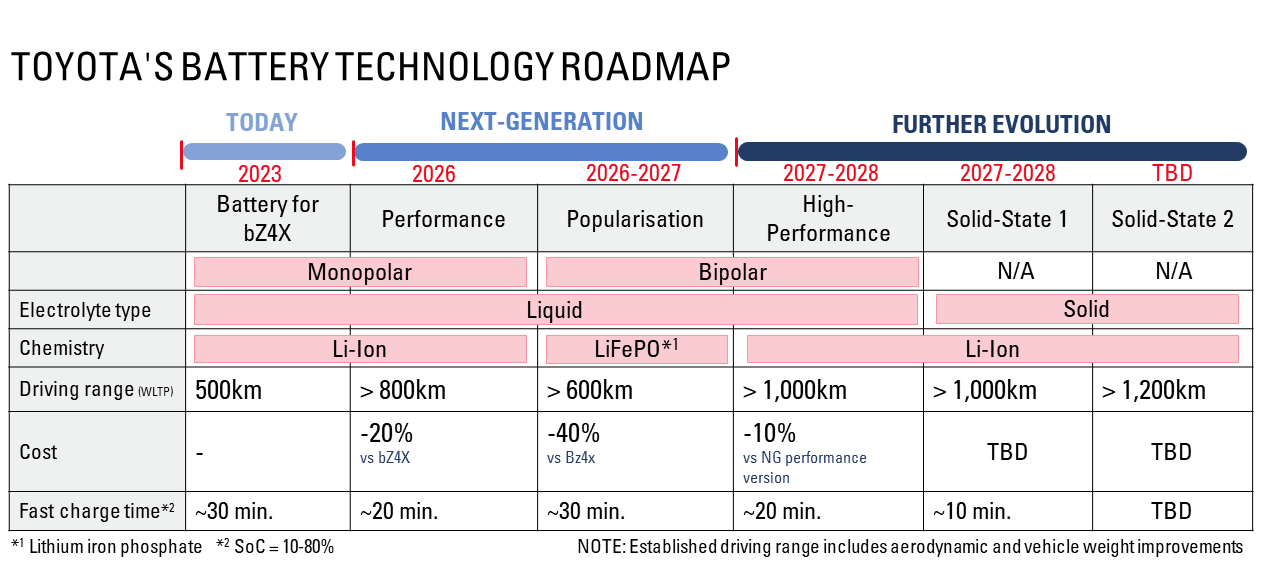
First solid-state EV 2027–2028; prototype claims 1,200 km (745 mi) range, sub-10-minute charging
|
|
Samsung SDI
|
SolidStack all-solid-state
|
Mass production H2 2027
|
|
BYD (FinDreams)
|
Sulfide-based all-solid-state
|
Limited batches 2027; mass production by 2030
|
Toyota's entry is worth a note of skepticism — the company has been promising solid-state batteries for nearly a decade, and its prototype claims (1,200 km range, sub-10-minute charging) remain exactly that. Industry observers have long noted the gap between Toyota's press briefings and delivered products. BYD's entry, meanwhile, comes with the credibility of executive vice president Stella Li's public commitment that the company will "prove" its leading position next year — and BYD is the world's number-two battery maker with its own vehicle brands to showcase the technology.
The pattern across all four: small or limited production in 2027, genuine mass-market availability around 2030. Anyone promising a solid-state EV you can buy next year is selling the future tense.
Don't Sleep on LFP and Sodium-Ion
Here's the twist that makes solid-state less of a cliff-edge moment: the technologies it's supposed to replace keep improving. As Electrek's analysis of the CATL news points out, CATL and BYD are simultaneously advancing LFP and sodium-ion batteries — chemistries that are already in mass production and getting better every generation.
BYD's second-generation Blade LFP batteries already deliver over 1,000 km (621 miles) of CLTC range, and 5C fast-charging LFP packs now power flagship sedans. Sodium-ion promises even lower costs for entry-level vehicles. By 2030, the "conventional" lithium-ion market solid-state batteries enter will be far more capable than today's — which means solid-state's advantages will need to be dramatic, not incremental, to command a premium.
For EV buyers, that's good news either way: competition between chemistries means every battery type keeps getting cheaper, safer and more capable.
What This Means for EV Owners Today
Practical takeaways from the solid-state roadmap:
- Don't postpone an EV purchase waiting for solid-state. Volume production is a 2030 story, first-model-year vehicles will carry a premium, and today's LFP batteries already cover most real-world needs — including the fast-charging performance that once seemed out of reach.
- Battery care matters across all chemistries. Whether your battery is LFP, NMC or eventually solid-state, longevity still depends on charging habits and heat management.
- Watch the regional rollout. New battery technologies typically debut in China first, then reach Europe, Australia and North America — which means charging standards and equipment compatibility continue to vary by market. Our guide to which charging adapters Chinese EVs need in the UAE explains why a car's birthplace determines its plug, and our coverage of the NACS transition shows how regional standards are still consolidating.
- The EV transition itself keeps accelerating regardless of chemistry — with EVs now outselling petrol cars in major markets like Germany — so the infrastructure and ownership experience are maturing on schedule even before the solid-state era begins.
The Bottom Line
CATL's 20 Ah trial cells and 500 Wh/kg target are real milestones from the company best positioned to industrialize them — and 2027's wave of limited solid-state production from CATL, Toyota, Samsung SDI and BYD will finally put the chemistry into real vehicles. But with the technology at "level four of nine" by the industry leader's own admission, the realistic era for mass-market solid-state EVs is 2030 and beyond. In the meantime, the humble LFP battery keeps getting so good that solid-state will have to earn its crown.
Frequently Asked Questions
When will CATL start producing solid-state batteries?
CATL expects to begin small-scale production of its sulfide-based all-solid-state batteries in 2027, with limited output scaling toward mass production around 2030.
What is CATL's solid-state battery energy density target?
500 Wh/kg — roughly double the energy density of today's best production cells (250–300 Wh/kg), enabling either double the range or the same range in a much smaller, lighter pack.
Which companies are launching solid-state batteries first?
Four major players converge on 2027: CATL (small-scale production), Toyota (first solid-state EV 2027–2028), Samsung SDI (SolidStack mass production in H2 2027) and BYD's FinDreams (limited batches in 2027). Mass-market availability lands around 2030.
How mature is solid-state battery technology?
CATL chairman Robin Zeng rated all-solid-state technology at "level four" on a scale of one to nine as of mid-2026 — promising, but less than halfway to full maturity.