Many potential EV buyers have the same worry lurking in the back of their mind: what if the battery ends up like an old laptop or phone, losing most of its usefulness after a few years? It's a reasonable question, and now there's real-world data to answer it. A recent independent study covering roughly 500,000 EV battery health tests offers one of the clearest pictures yet of how electric car batteries actually age — and the news is largely reassuring, with some important nuances worth understanding before you buy or charge.
The short answer: most EV batteries last for many years and hold onto the majority of their original capacity far longer than people expect. Degradation is a gradual process, not a cliff. A battery doesn't work fine one day and fail the next — it slowly loses a small amount of usable capacity over time and mileage, which shows up as a gradual reduction in range rather than a sudden loss of function.
A useful mental checkpoint is the 100,000-mile mark. Real-world data consistently shows that popular EVs still retain a large majority of their original battery capacity at that point — commonly somewhere in the 90% range, though this varies by model and how the car has been used. That's not a guarantee for every individual vehicle, but it reflects the general pattern seen across a large number of cars on the road today.
The data comes from Aviloo, an independent EV battery diagnostics company that has spent several years testing used electric vehicles through their onboard diagnostic ports rather than relying on dashboard estimates, which can vary between manufacturers. Its recently published Certified EV Battery Report compiled roughly 500,000 individual tests across 20 popular EV models, gathered between 2022 and 2026 from vehicles in North America, South America, Europe, Asia, and Australia.
The key metric is State of Health (SoH) — the percentage of a battery's original usable capacity that remains. A car showing 95% SoH should still deliver roughly 95% of the range it had when new. Aviloo measured median SoH at three mileage points: about 31,000 miles, 62,000 miles, and 93,000 miles.
The overall pattern was encouraging. At the shortest distance studied, every model in the dataset still showed a median SoH above 90%. Even at the highest mileage tested, most models clustered in the 90–94% range, as InsideEVs reported in its coverage of the study. The Hyundai Ioniq 5 performed particularly well in this dataset, topping the rankings at multiple mileage points — though that reflects this specific study rather than a universal claim about all EV batteries. A couple of older models with air-cooled battery packs, along with vehicles carrying unusually small batteries, showed somewhat faster degradation, landing in the mid-to-high 80s at the top mileage bracket — still a long way from being unusable, but a reminder that battery technology and pack size genuinely matter.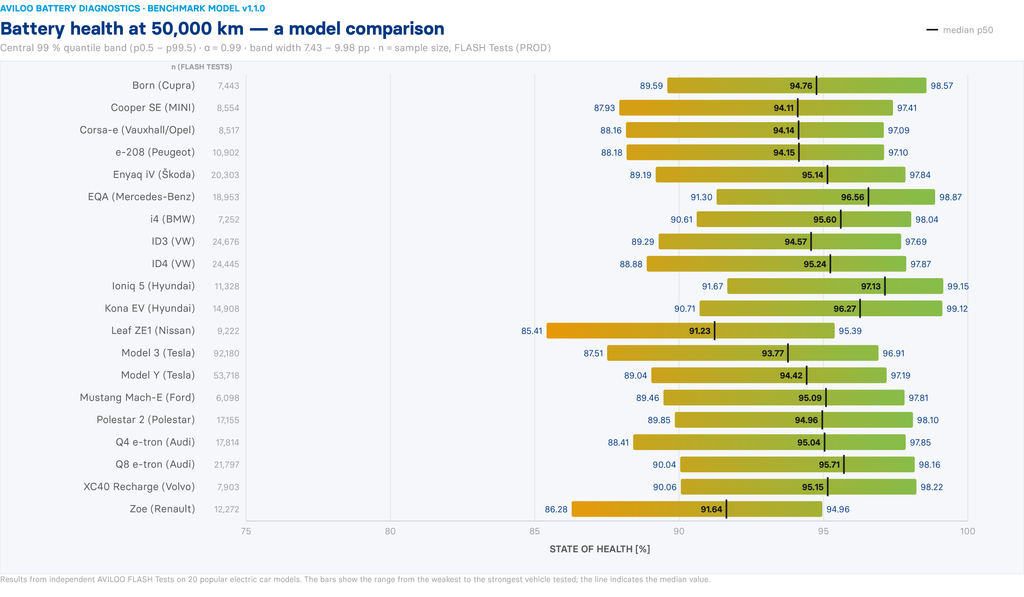
It's also worth noting that individual results varied meaningfully around these medians — in some cases by more than 10 percentage points between two examples of the same model and mileage, according to analysis of the report by electrive.com. Two cars of the same model and mileage can show noticeably different battery health depending on how each one was driven and charged, which is part of why the study frames these as typical outcomes rather than fixed guarantees. TechRadar's coverage of the study offers a further breakdown of how individual models compared.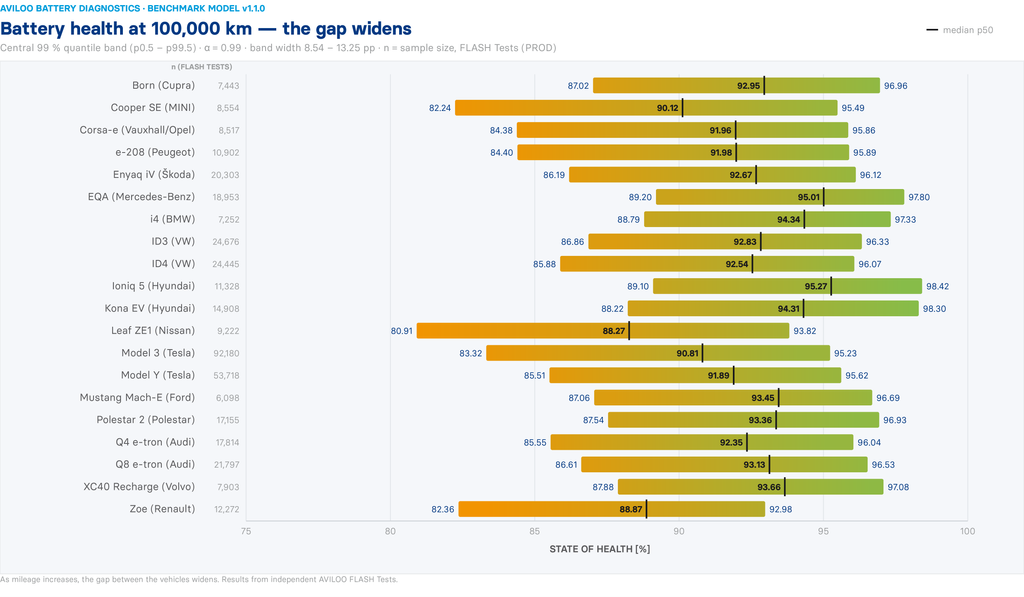
Several factors influence how quickly a battery loses capacity, and no single one tells the whole story:
None of these factors act alone, and their combined effect is why two similar cars can age differently.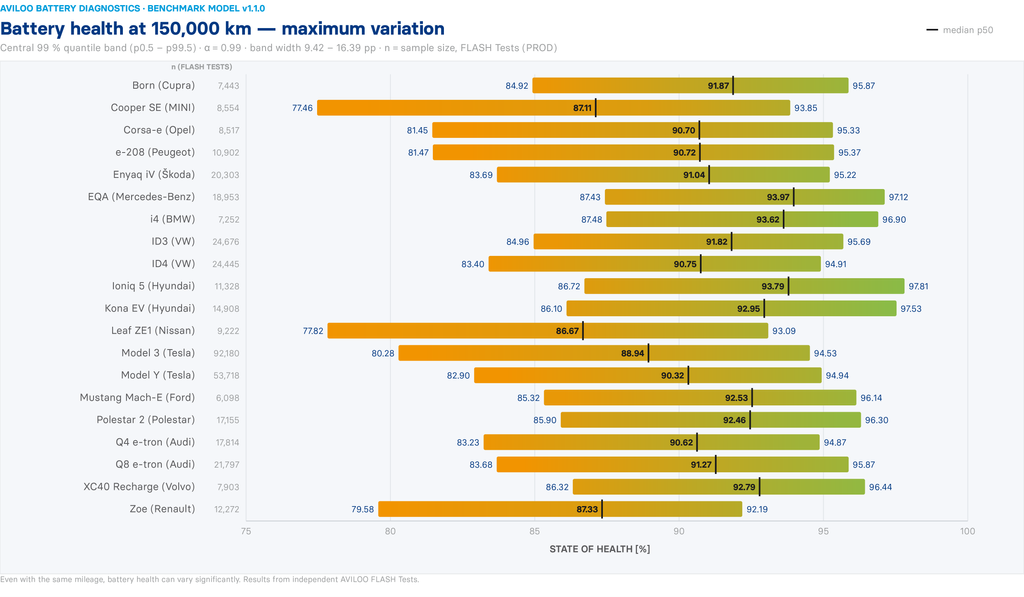
This is one of the most common concerns among EV owners, and the honest answer is more nuanced than a flat yes or no.
Modern EVs are built with battery management and thermal management systems specifically designed to handle DC fast charging safely. Using a fast charger occasionally, or even regularly when you genuinely need it, is not something owners need to be anxious about — it's a normal, intended part of how these vehicles are designed to be used.
That said, research generally suggests that very frequent high-power DC fast charging, especially without adequate thermal management or in extreme conditions, can contribute to somewhat faster degradation over time compared to charging that relies mostly on slower AC power. This doesn't make fast charging harmful — it makes it a tool best used when it's actually needed, such as on long trips, rather than as the default method for every single charge.
For day-to-day charging, when a car will be parked for a while anyway, AC charging is generally the more convenient and gentler option.
A few sensible habits can support long-term battery health, without any guarantees attached:
None of these steps eliminates degradation entirely — that's a normal part of how all lithium-ion batteries age. They're simply reasonable habits that align with how these systems are designed to be used.
A portable EV charger doesn't inherently protect or extend battery life — it's a charging tool, not a battery treatment. What it does offer is flexibility for AC charging, which, based on the habits outlined above, is generally the more convenient option for routine, everyday charging.
A portable charger is useful in a range of situations: charging at home without a dedicated wallbox installed, traveling and needing a charging option at a hotel or a friend's house, keeping a vacation home charge-ready, or simply having a reliable backup if your usual charging setup isn't available. Models with adjustable charging current allow drivers to select a suitable current based on the electrical supply that's actually available at a given location, which adds practical flexibility across different outlets and settings. Keeping any charger — portable or fixed — in good working order also matters for a consistent charging routine; see our guide to common EV charger (EVSE) problems and quick fixes if you ever run into issues.
Readers interested in flexible, everyday AC charging can explore MCEVKELN's portable EV charging solutions, designed for home, travel, and backup use.
How long do EV batteries last?
Most EV batteries last many years and retain the majority of their original capacity well past 100,000 miles. Degradation is gradual, not sudden, and studies of real-world usage show most popular models still perform well at high mileage, though results vary by model and usage.
How much do EV batteries degrade after 100,000 miles?
Data from large-scale battery health studies suggests many popular EVs retain around 90% or more of their original capacity near the 100,000-mile mark. Some models perform better, some slightly worse, and individual results vary based on driving and charging habits.
Does fast charging damage EV batteries?
Occasional or even regular DC fast charging isn't something to fear — modern EVs are built to handle it safely. However, relying on fast charging exclusively, rather than mixing in AC charging for routine use, may contribute to somewhat faster degradation over time in some conditions.
Is charging an EV to 100% bad?
Keeping a battery at a very high state of charge for extended periods can contribute to faster degradation in many EVs, unless your manufacturer specifically recommends full charges. For daily use, charging to a moderate level and reserving 100% for trips is a commonly recommended approach.
How can I extend EV battery life?
Follow your manufacturer's charging guidance, favor AC charging for everyday use, avoid leaving the battery at very high charge levels unnecessarily, use fast charging when you need it rather than by default, and be mindful of extreme heat when charging or parking.