BYD has spent the past year proving an EV can charge as fast as a gasoline car fills up. Its newest project attacks the problem on the other side of the cable: where does a charger that powerful actually get its electricity?
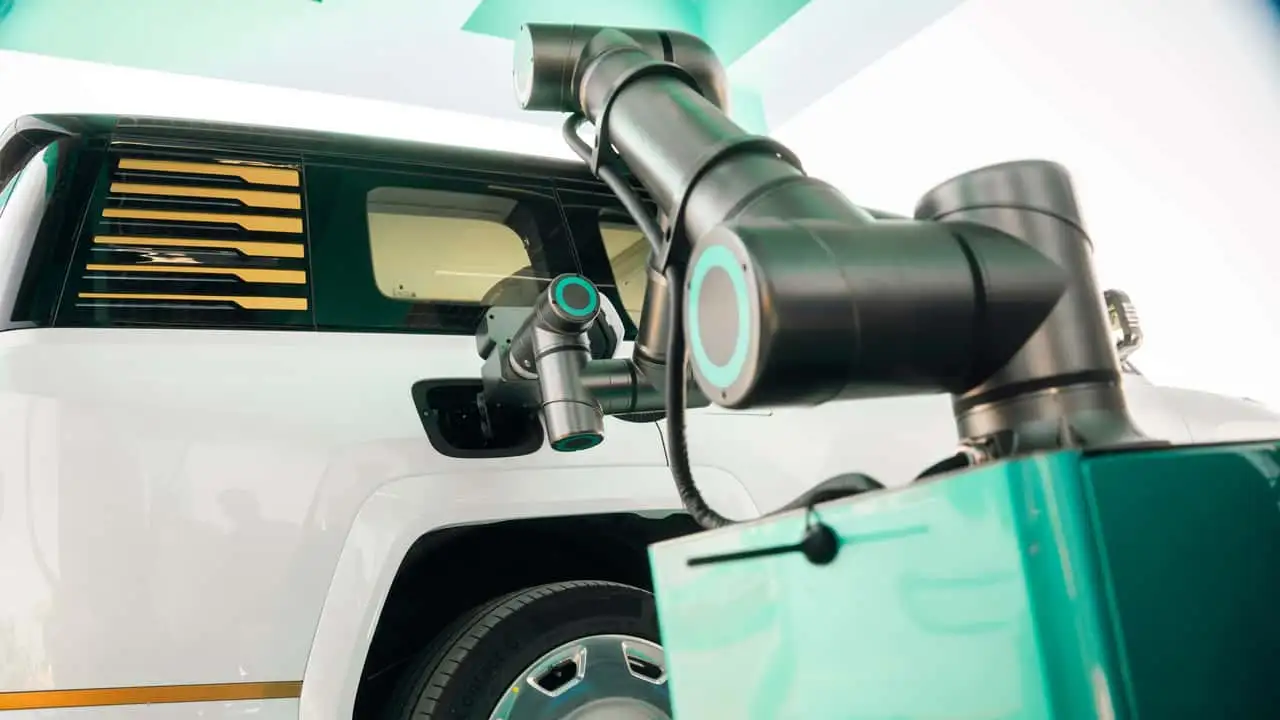
The answer is sitting in the Abu Dhabi desert. The site combines solar panels, battery storage, BYD's Flash Charging hardware and a robotic arm that plugs the car in — and BYD says the whole system can run independently of the electricity grid. The proposition is almost childishly simple: the sun generates, the batteries store, the charger delivers.
What makes it interesting is not the robotics. It is the arithmetic underneath.
The Numbers That Actually Matter: 100–560 kW In, 1,500 kW Out
Start with the standard BYD Flash charger, because it explains the design. Each T-shaped unit is hooked up to two 185-kilowatt-hour storage batteries — 370 kWh in total. Those batteries draw power from the grid at around 100 to 560 kW, then supply the car at a far higher rate: up to 1,500 kW through a single cable, or up to 1,000 kW when two chargers are working at the same time.
Read those two numbers against each other and the architecture explains itself. The grid is the slow, steady input; the batteries are the buffer that converts it into a violent, short output. A Flash charging station is, in effect, a battery that charges slowly and discharges ferociously — which is why the grid connection no longer has to match the peak the car experiences.
That buffering logic is the quiet reason the desert site can plausibly work off-grid at all.
Why Battery-Backed Charging Is Spreading
BYD is not inventing this category; it is scaling it. Battery-backed stations are becoming more common for exactly the reasons above: they let a site deliver more power than its grid connection alone could supply, and they flatten demand on the grid during busy periods.
The pattern is industry-wide. Tesla's biggest Supercharger site, opened earlier this year, pairs solar panels with Megapack batteries. Specialists like Electric Era and Beam Global have built businesses around battery-backed charging. Even BYD's own Flash chargers nowhere near a desert — the ones with no solar input at all — use on-site energy storage to boost delivery.
In other words, the Abu Dhabi site is not a gadget. It is the extreme case of a design the industry is already converging on, with the grid swapped out for sunshine. For the macro view of how charging infrastructure is scaling globally, the IEA's chapter on EV charging is the standard reference.
What the Desert Demo Doesn't Tell You
Here is the honest part, and BYD deserves some credit for not overclaiming it: the company has not disclosed the battery capacity or the solar output of this specific installation.
That omission matters. Without those two numbers, nobody can say how many cars the station can charge on solar power alone, or how quickly. "Off-grid" in a demonstration means the system can run independently — not that it can serve a Saturday rush indefinitely on sunshine. Until the site's generation and storage figures are published, the right way to read this is as a technology demonstration: the concept works, the throughput math is still BYD's to show.
The Robotic Arm and the Hands-Free Part
The part everyone will screenshot is the arm. It plugs the car in, working together with automated parking to make the whole charging stop hands-free: the car parks itself, the arm finds the port and connects.
The mechanics of that pairing are thin in the disclosures so far — what is confirmed is the combination of the robotic arm with automated parking, and that the result is charging without the driver handling a cable. In a desert environment, that is not a gimmick; it is the difference between a charging stop you can use at 45°C and one you would rather avoid.
1,500 kW Is Worthless Without a Car That Can Take It
A charger is only half of a charging session. The other half is the car.
With BYD's latest 1,500-kW Flash chargers, compatible vehicles running the second-generation Blade battery can go from 10% to 70% in five minutes, or reach 97% in nine minutes. That is the pairing the whole system is built around.
In Europe, the compatibility list is currently one vehicle long: the Denza Z9 GT, the only car BYD sells there that can fully use the chargers' power. During a demonstration, the electric wagon charged from 10% to 80% in six minutes and 32 seconds, hitting 97% in nine minutes and 22 seconds.
So the realistic sequence for most markets is: the stations arrive first, the cars that can drink from them arrive over years. Anyone buying an EV today should treat a "1,500 kW-compatible" site the way they treat any other spec — as potential, not as a promise their car can cash in.
The Rollout: 6,000 Stations by the End of 2027
BYD says it plans 6,000 Flash Charging stations worldwide by the end of 2027. What it has not specified is how many of them will offer solar power, off-grid operation, or the robotic arm — those are the variables that would tell you whether the desert site is a template or a one-off.
What is already running: Flash charging sites in Italy, Germany, France and the United Kingdom, with Canada coming soon. That footprint matters, because it means the buffering-plus-flash formula is being tested against real European grids and real European vehicles, not just demo deserts. BYD's official news and announcements page is the place to watch for the site-by-site details the company has not yet broken out.
What This Means Away From the Desert
The lasting idea here is not the arm. It is that fast charging is becoming an energy-management problem: generation, storage and delivery designed as one system, so that the grid stops being the bottleneck — and so that charging can reach places the grid never economically will.
That has two very different consequences. For infrastructure planners, battery-buffered fast charging is now a proven pattern, from Tesla's Megapack-backed sites to specialists like Beam Global. For the average EV owner, meanwhile, the hardware gap between a 1,500 kW desert station and what you can actually use today is enormous — and most real-world charging still happens where the grid is fine and the power is modest.
Which is why the practical kit for most drivers looks nothing like a megawatt cabinet. A reliable portable EV charger covers the overnight and emergency cases, and the right EV charging cables cover the public-network cases — the everyday complement to a future where stations like BYD's handle the extreme end.
FAQ
Can BYD's desert charging station really work without the grid?
BYD says the system — solar panels, battery storage and Flash Charging — can operate independently of the electricity grid. However, the company has not disclosed the site's battery capacity or solar output, so how many cars it can serve on solar alone, and how quickly, is not yet known.
How fast is BYD's Flash Charging?
With the latest 1,500-kW Flash chargers, compatible cars running BYD's second-generation Blade battery can charge from 10% to 70% in five minutes, or reach 97% in nine minutes. In a European demonstration, the Denza Z9 GT charged from 10% to 80% in 6 minutes 32 seconds and to 97% in 9 minutes 22 seconds.
How many Flash Charging stations is BYD building?
BYD plans 6,000 Flash Charging stations worldwide by the end of 2027. It has not said how many will include solar power, off-grid operation or the robotic charging arm. Sites are already operating in Italy, Germany, France and the United Kingdom, with Canada planned.
Do BYD's Flash chargers always use solar power?
No. Even BYD Flash chargers with no solar connection use on-site energy storage — two 185 kWh batteries per T-shaped charger, 370 kWh total — to draw from the grid at 100–560 kW and deliver up to 1,500 kW to the car.