| Breaker Rating | Usable Current (80%) | 230V (1-Phase) | 400V (3-Phase) |
|---|---|---|---|
| 16A | 12.8A | 2.9 kW | 8.8 kW |
| 32A | 25.6A | 5.9 kW | 17.6 kW |
If your home has only a 32A single-phase supply, achieving 11kW or 22kW charging speeds isn’t possible.
Voltage Drop:
Long cables or undersized wiring can cause voltage drops, lowering available power. A reduction from 230V to 220V can decrease a 7.4kW charger’s output to 7.1kW.
Dynamic Load Management:
Homes with total supply limits (e.g., 40A or 60A) may automatically reduce EV charging current to prevent overloading. If your heating system draws 15A, your EVSE can only use what remains — around 5.7kW instead of 7.4kW.
Even if your home can deliver full power, the EVSE itself may not always supply its rated output.
Rated vs. Actual Power:
Type 2 AC chargers in Europe are typically rated for:
3.7 kW (16A, 1-phase)
7.4 kW (32A, 1-phase)
11 kW (16A, 3-phase)
22 kW (32A, 3-phase)
Real-world output may be lower due to grid fluctuations, shared circuits, or thermal throttling in hot weather.
Load Sharing in Multi-EV Scenarios:
In public or apartment settings, charging stations often share power dynamically. If two EVs connect to a 22kW station, each may receive 11kW.
Thermal Management:
EVSEs include safety mechanisms to prevent overheating. When internal temperatures rise, the system will reduce power output automatically — protecting both your charger and vehicle.
Here’s the key: Even if your home and EVSE provide full power, your EV itself may not accept it.
Every electric vehicle contains an onboard charger (OBC) that governs how much AC power it can convert to DC for battery charging.
OBC Power Limit:
Most EVs have OBCs rated between 3.7 kW and 11 kW. Only a few premium models support 22 kW AC charging.
✅ Example: Plugging a Tesla Model 3 into a 22 kW AC charger will still result in an 11 kW charge rate, because the OBC caps the maximum input.
Battery Temperature and BMS Control:
If your battery is too cold or too hot, the Battery Management System (BMS) will reduce current to protect the cells.
For example:
In cold weather (-5°C), your EV may charge at half speed until the battery warms up.
In hot climates, the system may throttle charging to avoid overheating.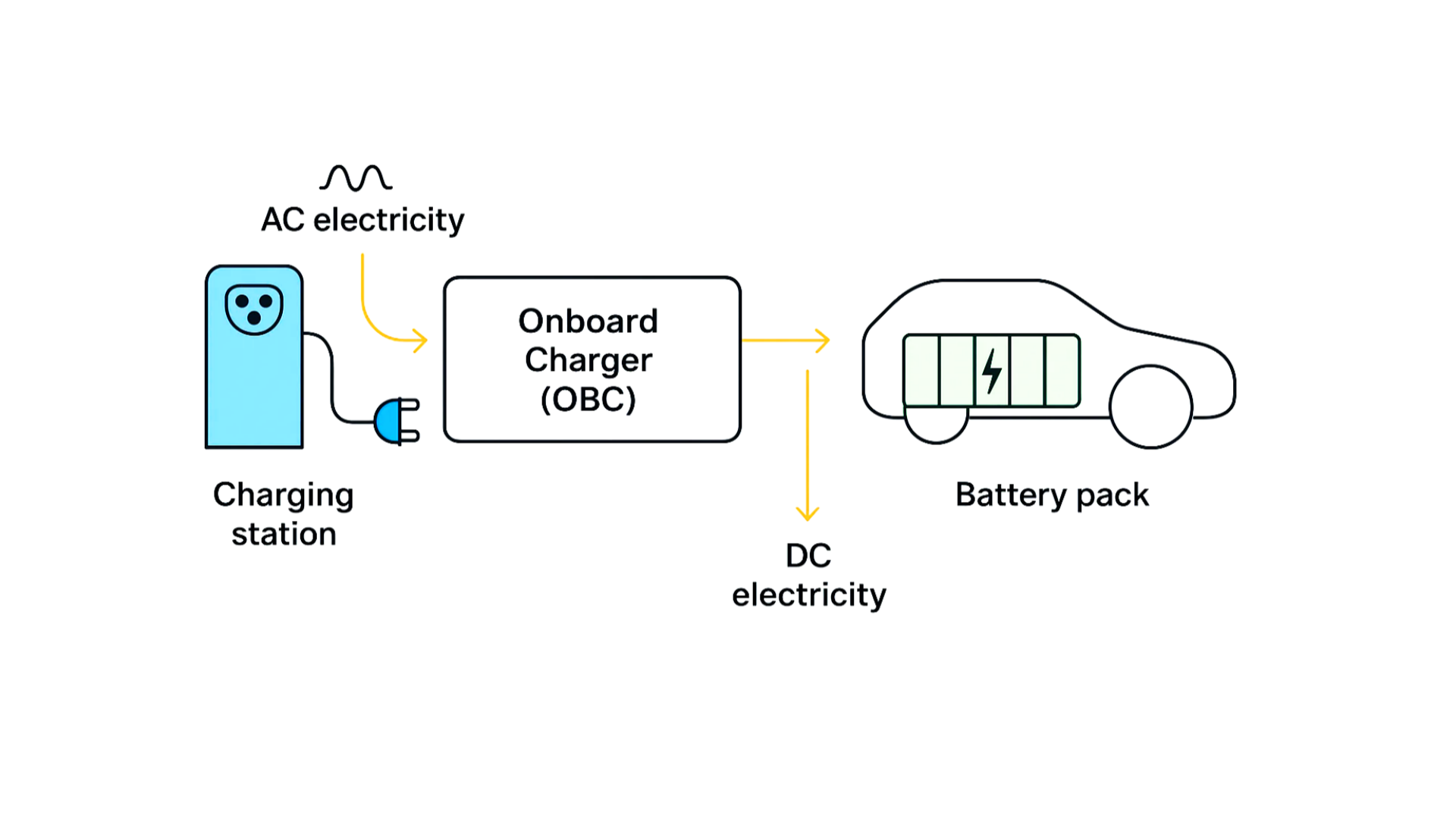
EVSEs are designed to be downward compatible — they will always deliver power within the safe limits defined by your EV’s OBC and electrical system.
A 22kW EVSE doesn’t force 22kW into your car; it only offers up to that capacity. The actual charging rate is always determined by the lowest common denominator among:
Your household’s available power,
The EVSE’s rated output, and
Your vehicle’s onboard charger (OBC) limit.
So if you notice your EV charging slower than expected, don’t blame the EVSE — it’s doing its job safely.
If you want your EVSE to always deliver the highest possible AC charging performance, choose a high-power, Type 2 22kW-compatible EVSE or cable.
This ensures full compatibility with:
1-phase and 3-phase power setups,
current and future EV models,
and the highest supported OBC capacities.
At MCEVKELN, we provide certified Level 1 and Level 2 EVSE solutions — including robust Type 2 22kW charging cables — designed for safe, stable, and reliable performance under all AC charging conditions.
Your EV’s charging speed is not always about the charger’s capability — it’s about system balance and smart power management.
While your MCEVKELN EVSE provides the safest and most efficient charging experience, your vehicle’s OBC, electrical circuit, and environmental conditions together determine the final charge rate.
Investing in a high-quality 22kW Type 2 EVSE ensures maximum compatibility, future readiness, and peace of mind — knowing your charging system is never the bottleneck.